
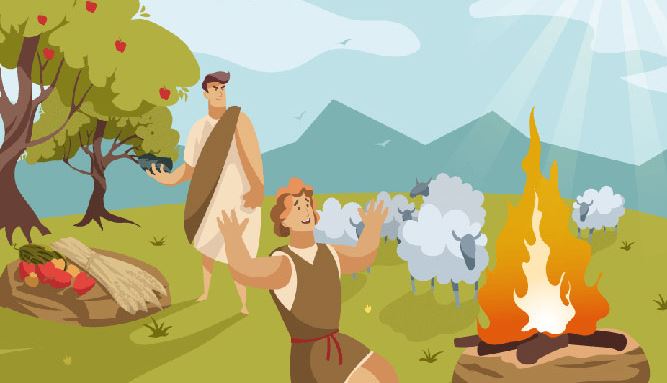
The Full Story of Cain and Abel
1. The Birth and Occupations
After being expelled from the Garden of Eden, Adam and Eve started their family.
Genesis 4:1-2: "Adam made love to his wife Eve, and she became pregnant and gave birth to Cain. She said, 'With the Lord’s help, I have produced a man!' Later she gave birth to his brother and named him Abel. When they grew up, Abel became a shepherd, while Cain cultivated the ground."
-
Cain: The firstborn, whose name may sound like the Hebrew for "brought forth" or "acquired." He was a "tiller of the ground," a farmer.
-
Abel: The younger brother, whose name means "breath" or "vapor," perhaps foreshadowing his fleeting life. He was a "keeper of sheep," a shepherd.
2. The Offerings to God
In the course of time, both brothers brought an offering to the Lord from the fruits of their labor.
Genesis 4:3-5: "When it was time for the harvest, Cain presented some of his crops as a gift to the Lord. Abel also brought a gift—the best portions of the firstborn lambs from his flock. The Lord accepted Abel and his gift, but he did not accept Cain and his gift. This made Cain very angry, and he looked dejected."
This is the central point of conflict. The text does not explicitly state why God favored Abel's offering over Cain's, but key differences are implied:
-
Abel's Offering: "The best portions of the firstborn lambs." This indicates faith, reverence, and giving the finest of what he had (the "firstfruits").
-
Cain's Offering: "Some of his crops." This seems more casual, not necessarily the first or the best. The New Testament commentary clarifies this (Hebrews 11:4): "By faith Abel brought God a better offering than Cain did."
The issue was not the content (grain vs. lamb) but the heart attitude behind the offering.
3. God's Warning to Cain
God, in His mercy, confronts Cain about his anger before he acts on it.
Genesis 4:6-7: "Why are you so angry?' the Lord asked Cain. 'Why do you look so dejected? You will be accepted if you do what is right. But if you refuse to do what is right, then watch out! Sin is crouching at the door, eager to control you. But you must subdue it and be its master.'"
This is a powerful metaphor. God pictures sin as a wild beast (like a lion) waiting to pounce on Cain. The choice is presented clearly: master the sin, or be mastered by it.
4. The Murder
Cain rejects God's warning and lets his jealousy and anger rule him.
Genesis 4:8: "One day Cain suggested to his brother, 'Let’s go out into the fields.' And while they were in the field, Cain attacked his brother Abel and killed him."
This is the first recorded death in the Bible—a fratricide, a murder of a brother.
5. God's Judgment
God, as He did with Adam and Eve, confronts Cain with a question, not because He doesn't know, but to give Cain a chance to confess.
Genesis 4:9-10: "Afterward the Lord asked Cain, 'Where is your brother? Where is Abel?' 'I don’t know,' Cain responded. 'Am I my brother’s keeper?' But the Lord said, 'What have you done? Listen! Your brother’s blood cries out to me from the ground!'"
The voice of Abel's shed blood itself testifies against Cain. The ground, which Cain was meant to cultivate, is now defiled by his brother's blood.
The Curse:
Genesis 4:11-12: 'Now you are cursed and banished from the ground, which has swallowed your brother’s blood. No longer will the ground yield good crops for you, no matter how hard you work! You will be a homeless wanderer on the earth.'"
The punishment is a reversal of Cain's identity:
-
He was a farmer, tied to the land. Now the land will not yield for him.
-
He was a settler. Now he will be a "homeless wanderer" (a "fugitive and a vagabond").
6. Cain's Plea and God's Mercy
Even in judgment, God shows mercy.
Genesis 4:13-15: "Cain replied to the Lord, 'My punishment is too great for me to bear! You have banished me from the land and from your presence; you have made me a homeless wanderer. Anyone who finds me will kill me!' The Lord replied, 'No, for I will give a sevenfold punishment to anyone who kills you.' Then the Lord put a mark on Cain to warn anyone who might try to kill him."
-
Cain's Fear: He realizes his vulnerability and that his violent act could now be done to him.
-
God's Protection: Despite Cain's crime, God still extends His protective grace by placing a mark on Cain. The nature of this mark is unknown—it was a sign of God's warning, not a stigma of shame, meant to preserve Cain's life.
7. The Aftermath
Genesis 4:16: "So Cain left the Lord’s presence and settled in the land of Nod, east of Eden."
"Nod" means "wandering." Cain fulfills his punishment, living out his days away from God's presence, in the land of wandering.
Summary and Significance
The story of Cain and Abel is more than a simple tale of fratricide. It powerfully illustrates:
-
The Progression of Sin: It shows how sin begins in the heart (jealousy, pride), is left unchecked (ignoring God's warning), and leads to destructive action (murder). James 1:15 echoes this: "After desire has conceived, it gives birth to sin; and sin, when it is full-grown, gives birth to death."
-
The Importance of the Heart in Worship: God looks at the heart and the faith behind our actions, not just the actions themselves.
-
Human Responsibility: God's question, "Am I my brother's keeper?" is answered with a resounding yes. We are indeed responsible for the well-being of our neighbors.
-
God's Justice and Mercy: God judges sin decisively, but even in His judgment, He shows mercy and protection to the guilty.


