
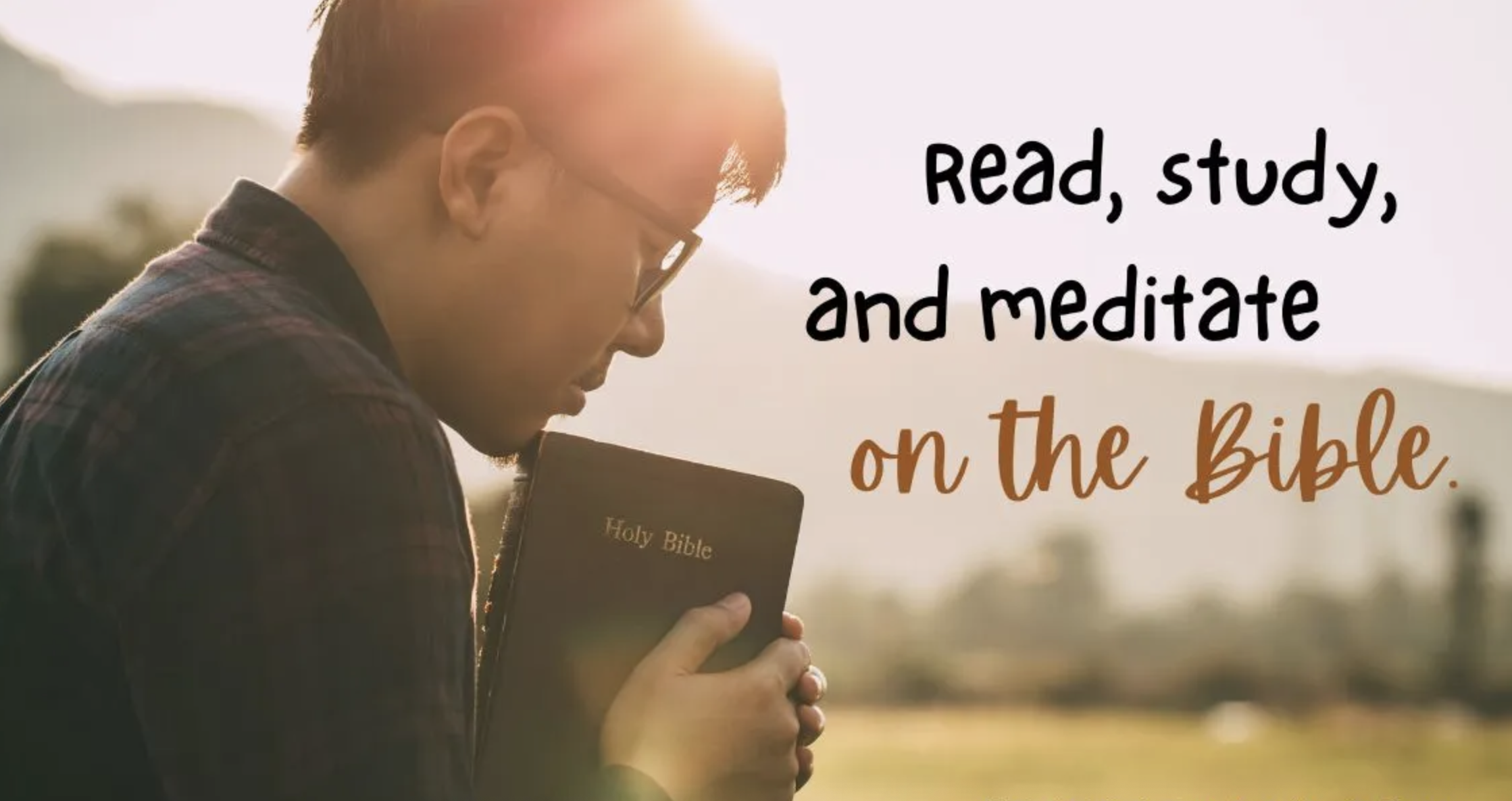
The Sacred Echo: Transforming Your Life Through Meditation on God's Word
Primary Text: Joshua 1:8 (NIV)
"Keep this Book of the Law always on your lips; meditate on it day and night, so that you may be careful to do everything written in it. Then you will be prosperous and successful."
Call to Worship: Psalm 1:1-3
(Introduction: The Noise and the Whisper)
Good morning, church. If you have your Bibles, you can open them to the Book of Joshua, chapter 1.
I want you to think about the last time you were truly, deeply still. No phone in your hand, no podcast in your ears, no screen flickering in front of you, no mental to-do list running on a loop. For many of us, that kind of stillness is rare and even uncomfortable. We live in a world of constant noise and endless input. We are consumers of information, but we are rarely cultivators of wisdom.
In this storm of distraction, we often approach the Bible like we approach everything else: we scroll it. We skim a chapter, looking for a quick nugget of inspiration, a spiritual soundbite to get us through the day. And while God can use even that, He invites us into something so much deeper, so much more transformative. He doesn't just want us to read His Word; He commands us to meditateon it.
This morning, we are going to explore this forgotten, powerful spiritual discipline. We’re going to see that meditation is God's primary tool for moving His truth from the pages of a book into the fabric of our lives.
I. The Picture of Meditation: What It Really Is
When we hear the word "meditation," our minds often go to Eastern practices of emptying the mind, achieving a state of Zen, or focusing on one's breath. But biblical meditation is the exact opposite. It is not about emptying the mind, but about filling it. It’s not about achieving silence, but about hearing a Voice.
The Hebrew word God uses in Joshua 1:8 is "hagah." It’s a robust, sensory word. It means:
-
To murmur: To speak something under your breath.
-
To mutter: To rehearse it quietly.
-
To ponder: To think deeply about something.
It’s the word used in Isaiah 31:4 to describe a lion growling over its prey. A lion doesn’t just swallow its food whole. It tears it, chews it, and consumes it, drawing out every bit of nourishment. That is the picture of hagah—to gnaw on the Word of God, to chew on it, to digest it slowly and thoroughly until its life becomes our life.
Biblical meditation, then, is the active and deliberate process of engaging with Scripture—by reading it, speaking it, praying it, and pondering it—until it sinks from our heads into our hearts and begins to reshape our desires, our thoughts, and our actions.
It’s taking a single verse, like Psalm 23:1, "The LORD is my shepherd; I shall not want," and not just reading it, but dwelling on it.
-
"The LORD"—the covenant God, the great I AM, the creator of the universe.
-
"Is my shepherd"—not a distant God, but a personal, caring, guiding, protecting presence in mylife.
-
"I shall not want"—because if the God of all is personally caring for me, what true, eternal need could possibly be left unmet?
This is meditation. It is giving God’s Word a sacred echo in the chambers of our soul.
II. The Promise of Meditation: Why We Do It
God doesn’t issue commands arbitrarily. Every command is a gateway to grace; every instruction is an invitation to blessing. And the promise attached to meditation is both profound and practical.
Look at the divine logic in Joshua 1:8:
-
Meditate on the Word.
-
Result: You will be careful to obey it.
-
Result: Then you will be prosperous and successful.
The bridge is absolutely crucial: Meditation leads to Obedience. Why? Because we do not consistently do what we do not deeply believe. And we will not deeply believe what we do not consistently contemplate.
You can't just will yourself to be more patient. You have to meditate on the patience of Christ.
You can't just decide to be less anxious. You have to dwell on the promises of God's provision and peace.
You can't just try harder to love difficult people. You have to soak in the reality that "while we were still sinners, Christ died for us" (Romans 5:8).
Meditation rewires our default responses. It moves truth from the conference room of our intellect to the control center of our heart.
And the result? A life of prosperity and success in God's eyes. This isn't the health-and-wealth gospel. For Joshua, it meant success in conquering the Promised Land—fulfilling his God-given destiny. For us, it means a life of spiritual victory, fruitfulness, and profound purpose. It is the picture we see in Psalm 1. The one who meditates is like a tree.
-
Planted by streams of water: Its source of life is constant and unfailing.
-
Yields its fruit in season: It is productive and effective in the rhythms of life.
-
Whose leaf does not wither: It is resilient in drought and difficulty.
-
Whatever they do prospers: Its endeavors, aligned with God's will, flourish.
This is the promise: Stability, Resilience, and Fruitfulness. Not because your circumstances are easy, but because your roots are deep in the River of Life.
III. The Practice of Meditation: How We Can Do It Today
"So, Pastor," you might say, "this sounds wonderful. But I have a job, kids, responsibilities. How do I actually do this?" Let me give you a simple, practical method. You can remember it with the acronym S.O.A.P. It stands for Scripture, Observation, Application, Prayer.
Let's practice it right now, together, with a verse. Let’s take Philippians 4:6-7: "Do not be anxious about anything, but in every situation, by prayer and petition, with thanksgiving, present your requests to God. And the peace of God, which transcends all understanding, will guard your hearts and your minds in Christ Jesus."
-
S - SCRIPTURE: Write it down. Don't just read it. The physical act of writing engages your brain. "Do not be anxious about anything..."
-
O - OBSERVATION: Ask questions. What does this say?
-
What is the command? "Do not be anxious... but in every situation, pray."
-
What are the conditions? "With thanksgiving."
-
What is the promise? "The peace of God... will guard your hearts and minds."
-
What does "transcends all understanding" mean? It’s a peace that doesn't make logical sense given your circumstances.
-
What does "guard" mean? It’s a military term—to stand as a sentry, protecting your inner self from the invasion of fear and worry.
-
-
A - APPLICATION: This is where it gets personal. How does this truth apply to my life today?
-
"What is making me anxious right now? Is it a health scare? A financial pressure? A relational conflict?"
-
"God is commanding me to bring that specific thing to Him, not with complaining, but with a heart of thanksgiving for who He is."
-
"My application today is: When I feel the wave of anxiety about [my specific situation], I will stop and pray, thanking God that He is in control, and I will consciously choose to trust His peace to stand guard over my emotions."
-
-
P - PRAYER: Turn the Scripture into a conversation with God.
-
"Lord, you see my anxiety about [my situation]. Your Word commands me not to be anxious, but I confess that I am. I am bringing this to you now, in prayer. Thank you that you are sovereign. Thank you that you care for me. I ask for your peace—that supernatural, unexplainable peace—to stand guard over my heart and my mind right now. I trust you with this. In Jesus' name, Amen."
-
This is meditation. It takes 10-15 minutes. You can do it with one verse over your morning coffee, on your lunch break, before you go to bed.
(Conclusion: From the Page to the Pavement)
Church, the choice is stark. We can be shaped by the relentless, chaotic noise of the world, or we can be transformed by the renewing of our minds (Romans 12:2). God’s Word is not a lucky charm; it is our daily bread. And meditation is how we eat it.
This is not a call to more religious guilt. It is an invitation to profound grace. It is God’s method for making us more like Jesus, not by our own striving, but by the Spirit applying the truth we have diligently pondered.
You don’t need a theology degree. You just need a Bible, a willing heart, and 10 minutes. Start this week. Pick one verse. Write it on a notecard. Put it on your mirror. S.O.A.P. it. Chew on it. Let it be the sacred echo in your soul.
For when we meditate on His Word, we stop just walking past the river, and we finally put our roots down into it. And we become, as Psalm 1 promises, a people who cannot be shaken.


